
An hour and a half into my Clown 101 workshop in Tucson, I gave students “impossible” tasks: folding a fitted sheet, putting a balloon atop an imaginary shelf, etc. One was to throw a handkerchief into a hat sitting a few paces away. The catch? They couldn’t ball up the handkerchief. It had to be thrown loose, making it almost impossible to control where it landed.
I demonstrated a couple of attempts, both predictably unsuccessful. The whole point of the exercise was to practice failure, or more specifically, notice how we respond when things don’t go according to plan and to share that reaction with the audience. Then the first student to try it stepped up, tossed the handkerchief, and landed it almost perfectly in the hat on the first try.
The crowd went wild.
We’d been preparing to appreciate failure, but instead we got to celebrate a completely unexpected success. It was a perfect little lesson in clowning: the magic isn’t in succeeding or failing. It’s in allowing ourselves to be genuinely affected by what happens and inviting the audience to share the experience.
You Don’t Have to Be Funny to Be a Clown
There are many schools and traditions of clowning, each with its own techniques and philosophies. My approach draws heavily on the work of Avner the Eccentric and emphasizes presence, curiosity, vulnerability, and the relationship between performer and audience. The goal isn’t to put on a red nose, invent a wacky character, or learn a collection of gags. It’s to discover what happens when we stop hiding behind our desire to be clever, impressive, or competent.
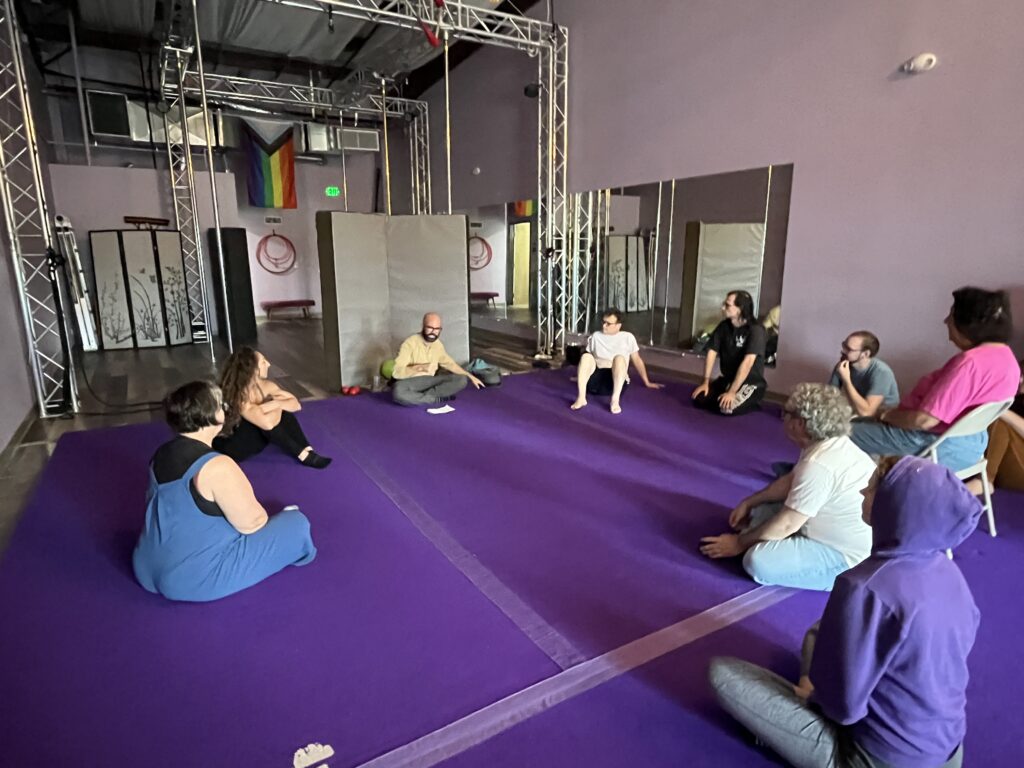
We began the three-hour workshop with exercises exploring movement, breathing, and awareness. From there, we practiced rediscovering curiosity, allowing ourselves to be seen, and treating the audience as a collaborator rather than a group of people to impress. Something as simple as taking a breath, making eye contact, or acknowledging a mistake can completely transform a performance.
It’s surprisingly difficult to do nothing onstage. We’re so accustomed to filling silence, explaining ourselves, and trying to make something happen that simply being present can feel like an enormous risk. Fortunately, that’s where things start getting interesting.
The Fine Art of Getting It Wrong
As the workshop progressed, we began giving ourselves simple tasks and allowing things to go wrong. A jacket sleeve became an unexpected adversary. A fitted sheet proved that it was, as many of us have long suspected, designed by someone with a personal grudge against humanity. Even placing an imaginary balloon on an imaginary shelf became an exercise in discovery and delightful frustration.
We also introduced some circus skills into the mix. There was tremendous bravado with a diabolo, unfortunate entanglements in aerial silks, and an attempt to wear a juggling hat already occupied by a collection of juggling balls.
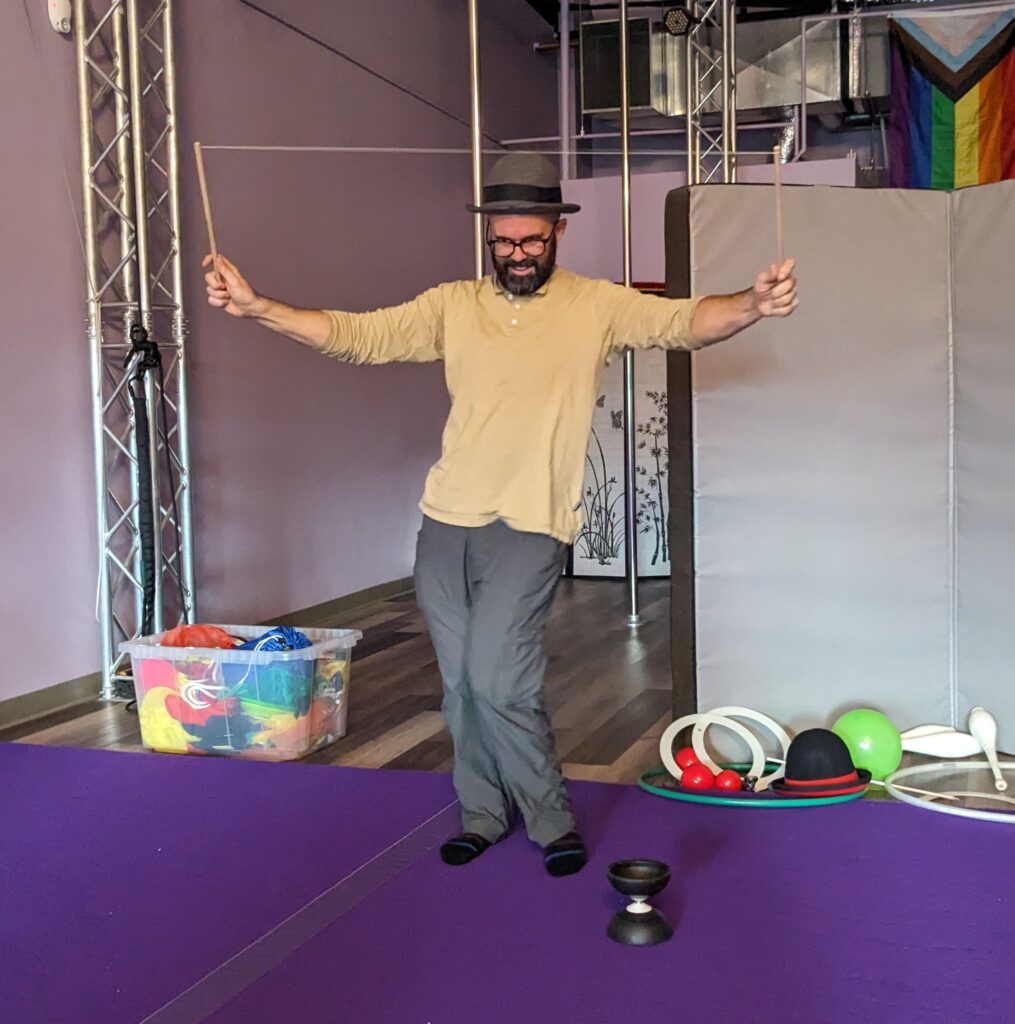
What made these moments funny wasn’t the difficulty of the tricks or the absurdity of the situations. It was watching people genuinely struggle, discover, react, persist, and share those experiences with us. The audience wasn’t waiting for a punchline. We were along for the ride.
And as our handkerchief-throwing champion demonstrated, the successes could be just as entertaining as the failures.
Finding Your Own Clown
Perhaps my favorite part of the workshop was watching participants put everything together. Over just three hours, people with very different backgrounds, including some who had never performed before, developed and presented their own short clown routines.
Several participants commented on how naturally the exercises built toward that final experience. What had initially seemed intimidating became surprisingly accessible, and there was plenty of enthusiasm for doing more.
That’s what I hoped people would discover. Clowning isn’t necessarily about learning to be someone else. Sometimes it’s about letting people see more of who you already are, including the awkward, uncertain, ridiculous parts that we normally work so hard to conceal.
Clowning, Play, and the Pleasure of Not Knowing
This is also why clowning has become such an important part of my broader work exploring adult play. As adults, we often approach activities with a particular outcome in mind. We want to improve, accomplish something, or at least avoid looking like we have no idea what we’re doing. Play offers us something different: an opportunity to experiment, explore, and discover without needing to know where we’re headed.
Clowning makes that process visible. An audience gets to witness someone encounter a problem, make a discovery, experience a setback, or stumble into an unexpected triumph. And because the performer shares those experiences rather than hiding them, we get to participate in the discovery ourselves.That’s a big part of what interests me about play in general. It isn’t just a pleasant distraction from the serious business of being an adult. It’s a way of engaging with the world that makes room for curiosity, uncertainty, connection, and surprise.
Interested in Clown Classes in Tucson?
I’m exploring possibilities for future Clown 101 workshops and other clowning classes in Tucson, including standalone workshops and more ongoing opportunities to play.
Whether you’re an experienced performer, an aspiring clown, or simply someone curious about trying something completely different, you’re welcome. No experience, funny costume, or red nose required.
[Check back here or my Instagram for upcoming workshops, or get in touch if you’d like to hear about future classes.]
When we stop worrying so much about the outcome, we make room for something unexpected. And sometimes, against all expectations, the handkerchief lands in the hat.